
RESEARCH BEHAVIOUR INTELLIGENCE
See the research system, not just the metrics.
Research Behaviour Intelligence shows how an organisation's research activity is organised, how it is changing, and where leadership attention is most likely to matter.
It combines governed public evidence with confidential institutional data to connect people, activity, relationships, economics and outcomes that are usually examined separately.
THE LEADERSHIP PROBLEM
Most research reporting tells you what happened. It rarely tells you how the organisation is changing.
Income, awards, applications and rankings remain important, but they are outcomes of a more complex research environment. Leadership decisions also depend on understanding who participates, how activity is distributed, where relationships persist, how capability develops and what those changes mean for future direction.
RBI brings those signals into view before they are fully visible in headline metrics.
What is it costing?
Recovery, subsidy, capacity and portfolio choices can create financial consequences measured in millions.
Where is it heading?
Patterns of participation, activity and flow can reveal direction long before year-end metrics explain what happened.
Is capability emerging?
Participation, leadership, collaboration and recurring relationships leave observable signs of emerging capability.
BEYOND DASHBOARDS, KPIs AND SNAPSHOTS
RBI connects evidence that is usually analysed separately.
Funding, institutional applications, people and roles, portfolio economics, partnerships and wider outcomes describe different parts of the same system. RBI keeps their evidential boundaries intact while analysing how the patterns relate over time.
RBI reconstructs the behaviour and evolution of a research system through five connected lenses.
Purpose
What is the institution trying to build, change or protect?
Stock
What people, leadership, relationships, awards, capability and portfolio are currently in the system?
Flow
What is entering, leaving, recurring, progressing or changing through time?
Economics
What does the system cost, where is subsidy generated, and how is capacity being used?
Outcomes
What funded, organisational and wider-value consequences are becoming visible?
External system
Funding trajectories, policy context, comparable institutional evidence, benchmarks and other public sources.
Institutional evidence
Gateway, finance, people, applications, successful and unsuccessful activity, leadership, recurrence and portfolio formation.
Wider value and outcomes
HE-BCI, partnerships, knowledge exchange, commercialisation, engagement and other institutional outcomes.
PORTFOLIO ECONOMICS
Research economics are shaped by how portfolios are configured, not just by how much activity there is.
Two organisations with similar levels of research activity can carry very different economic exposures. Recovery, concentration, scale and the distribution of effort all influence whether growth is sustainable.
Your portfolio structure is your people story. RBI connects financial performance to the underlying activity that produces it.
Who participates, who leads, returns and how teams form and develop can shape the portfolio that follows. Resilience and income density are differentiators.
SPRE AND YOUR RESEARCH ENVIRONMENT
Gateway is the confidential institutional evidence layer within RBI, linking applications, roles, participation and leadership over time in ways that public comparator data usually cannot.
Gateway is explicitly not ranking: it helps shape precision development for cadres of people.
Gateway enriches the client view; comparator evidence remains separately sourced and like-for-like. Illustrative exemplar using synthetic data.
People development matters when it changes the research environment.
Strategy, People and Research Environment (SPRE) needs evidence of whether an institution is building the participation, leadership, relationships and conditions needed by its strategy. RBI makes those changes observable by tracing how people enter, connect, develop and recur across research activity.
The aim here isn’t counting development activity, but instead to see whether capability is actually forming. RBI shows who, how, what, where, and financial sustainability together as one people-centric infrastructure: this is what SPRE is really trying to understand.
COMMUNITY DISCOVERY
Discovery can explore structures that conventional reporting does not show.
Discovery maps communities, connection patterns and points of interdependence across research activity, then tests how those patterns change under controlled perturbation.
Illustrative exemplar using synthetic data. The method identifies structures for further interpretation; it does not by itself establish resilience, quality or investment priority.
This can reveal where resilience depends on particular people, bridges or relationships, without assigning labels or performance judgements to communities.
INSTITUTIONAL TRAJECTORY
Trajectory shows whether an organisation is strengthening, concentrating, fragmenting or changing form.
Two institutions can look similar today and still be moving in very different directions. RBI helps organisations see how people, relationships, capability and activity are evolving together over time.
That makes it possible to understand not only where an institution is heading, but how its direction is shaped by, and contributes to, the wider research landscape.
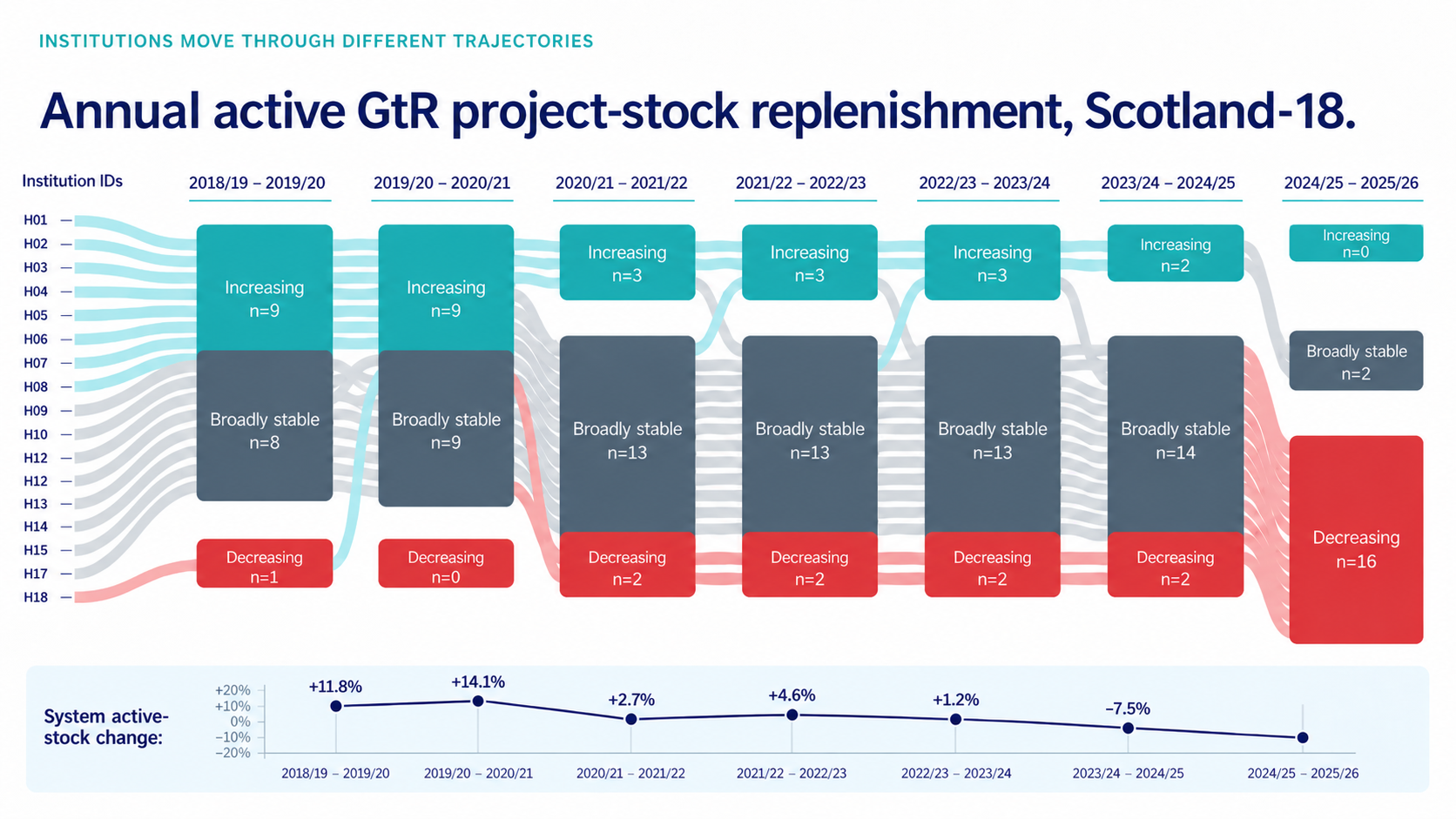
This example shows how the 18 universities headquartered in Scotland contribute distinct trajectories to the national research system. Each strand contains temporal evidence about how people, teams, networks and institutional activity evolve over time. RBI combines these trajectories across funders and sources to show not only how an institution is changing, but how its direction contributes to and is shaped by the wider research landscape.
PARTNERSHIPS, COLLABORATION AND NETWORKS
Research systems leave different signatures on sectors and places
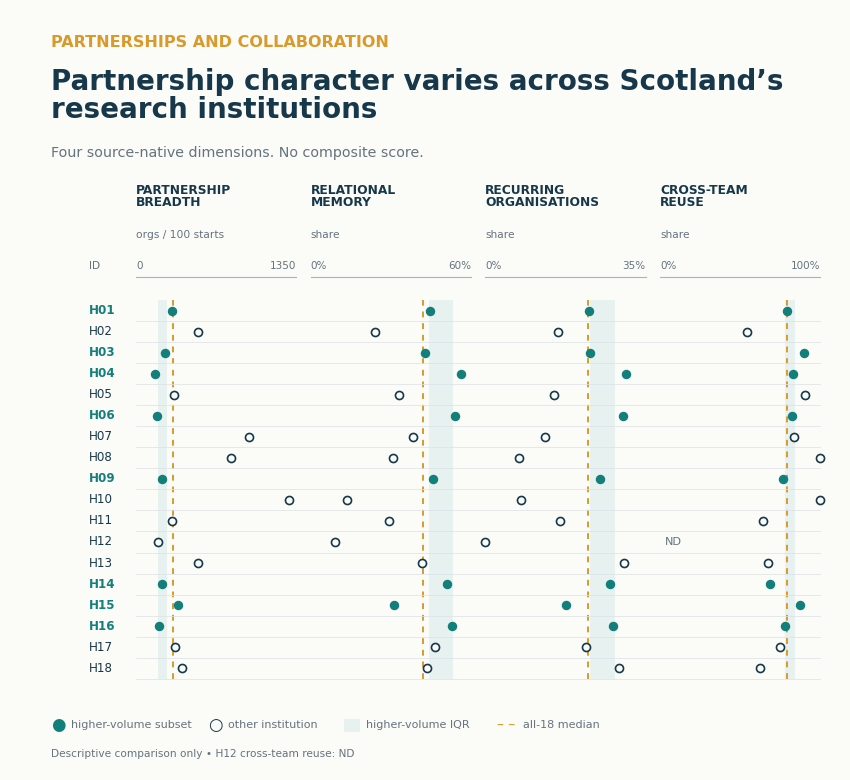
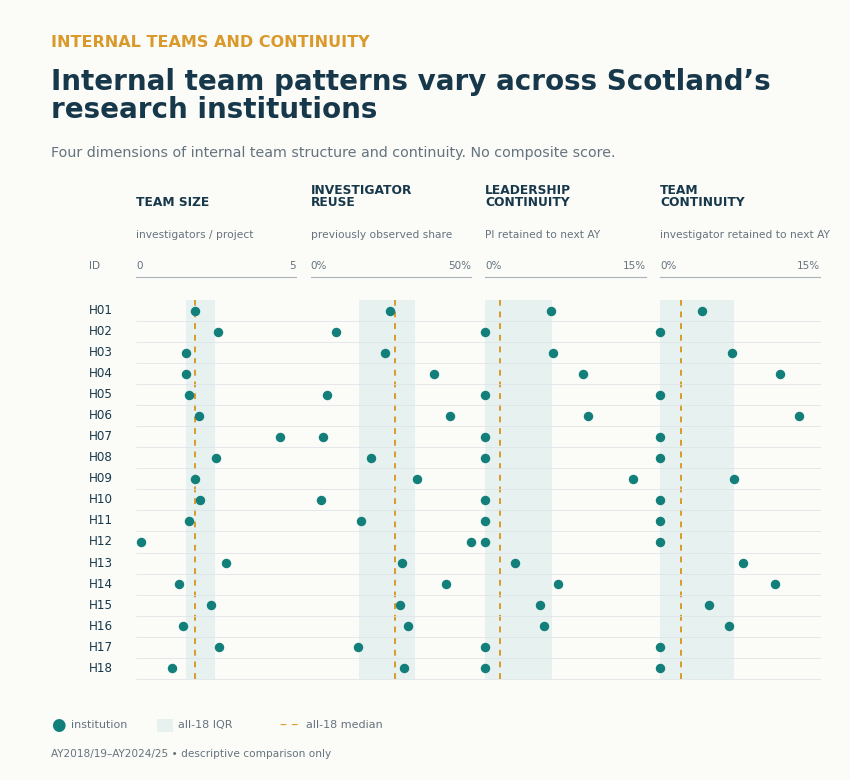
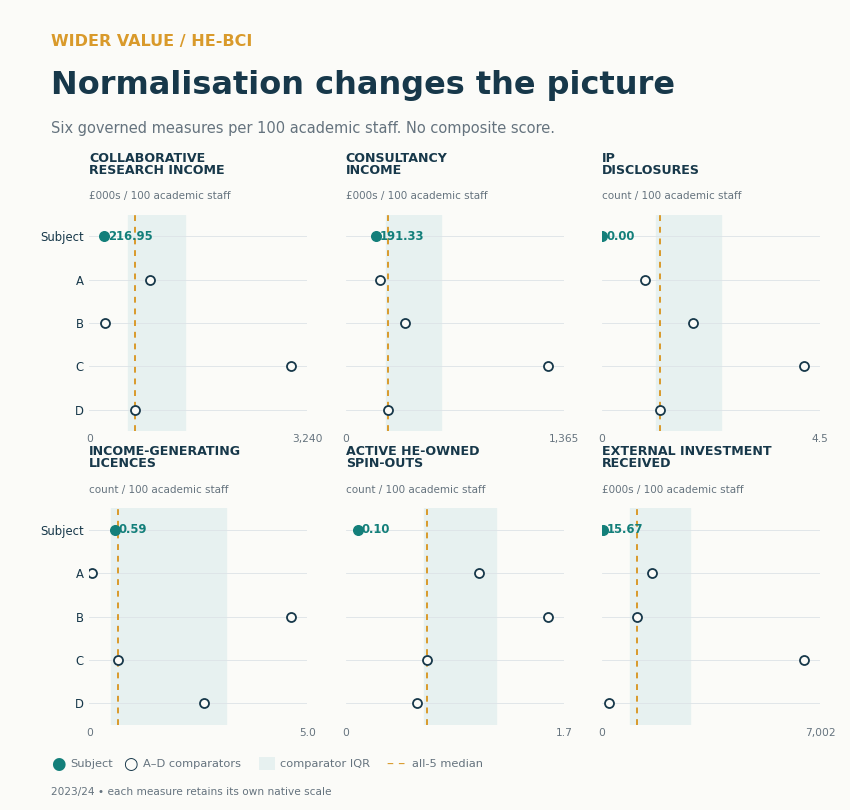
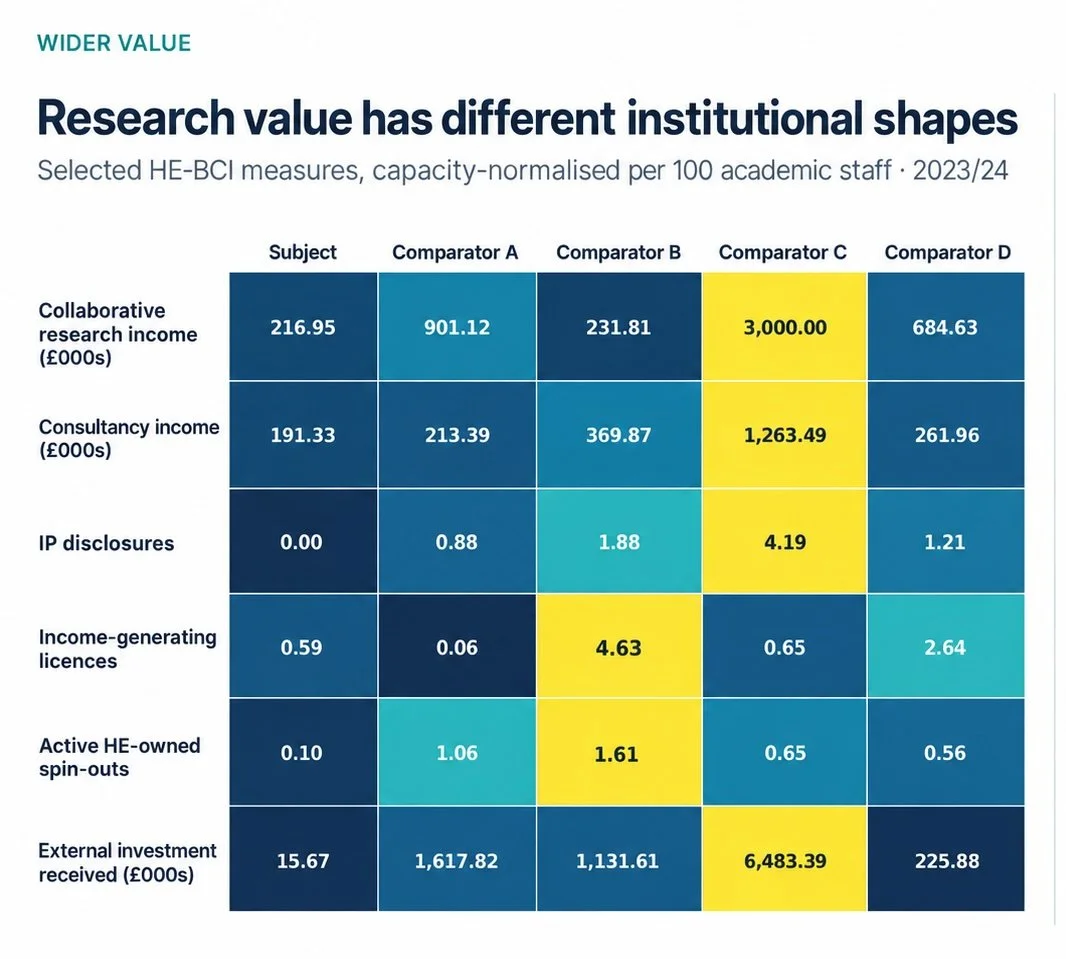
RBI does not collapse these dimensions into a single score. The insight lies in understanding how the patterns combine to reveal the wider research system.
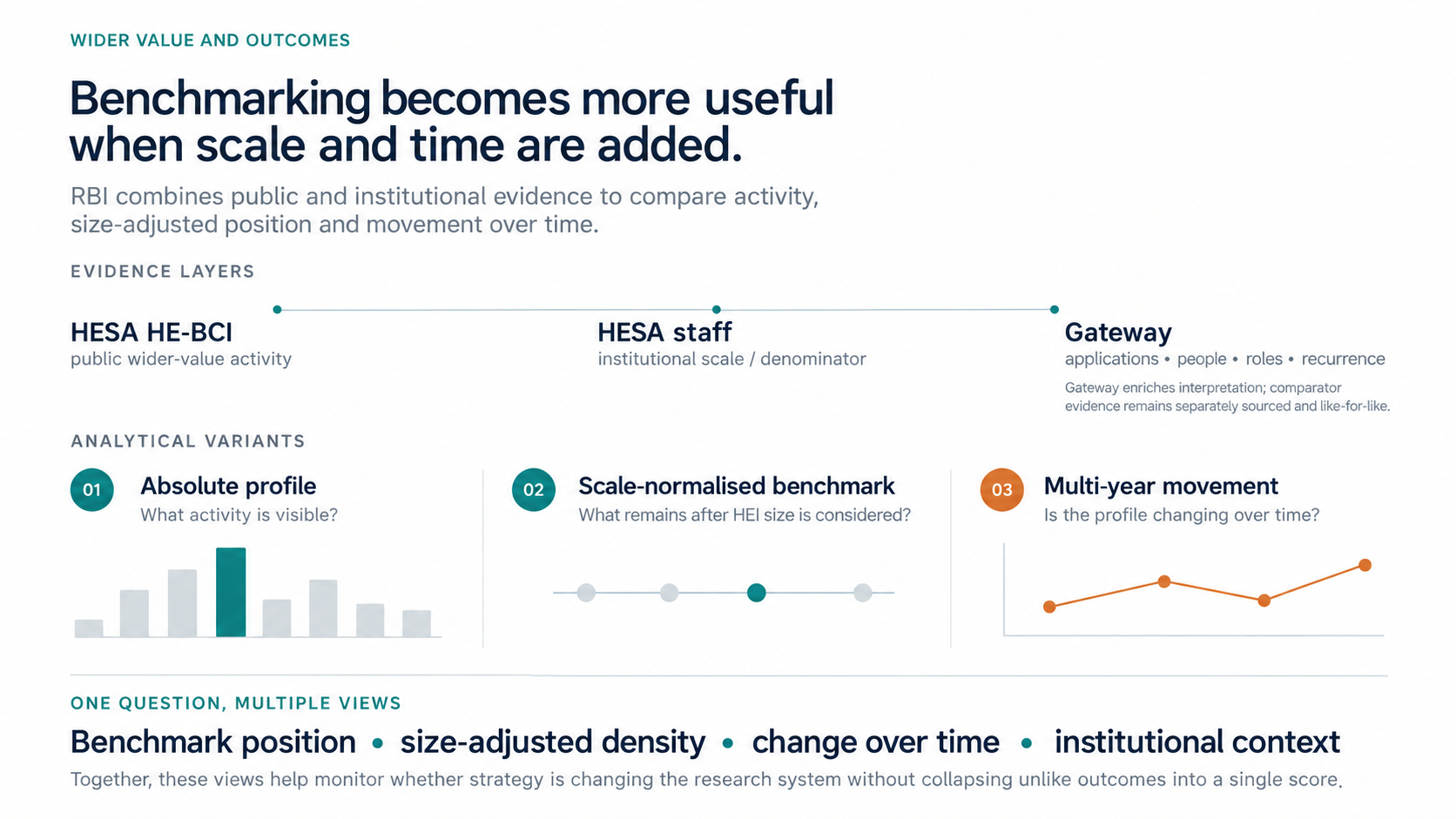
with value much wider than grant income.
Partnerships, internal teams and wider-value outcomes reveal different dimensions of the same organisation and different characters between peer groups.
Precision is important.
RBI prioritises people-centric evidence of how capability is forming and changing, from participation and behavioural cadres through relationships, development pathways and institutional patterns, before making stronger claims about what may happen next. Understanding capability allows targeted, precision development to support people when they need it.
CONNECTING EVIDENCE TO INFORMED LEADERSHIP CHOICES
Every substantive factual claim is traceable through the evidence chain to its admitted source data.
Purpose
What is the institution trying to build, change or protect?
Stock
What people, leadership, relationships, awards, capability and portfolio are currently in the system?
Flow
How are people, proposals, awards, relationships and resources moving through the system over time?
Economics
Where are value, effort, recovery and economic exposure concentrated?
Outcomes
What wider outcomes, partnerships and institutional capabilities are emerging?
What an RBI engagement delivers
RBI is a confidential, evidence-led strategic diagnostic for universities, research organisations, funders and sector bodies.
It can be commissioned as a focused diagnostic, a deeper institutional review, or as part of a wider strategy, SPRE or research-environment exercise.
If you want to understand how your research activity is changing, where capability is emerging, and what deserves leadership attention next, get in touch.
Developed by Duddingston Consultancy, drawing on senior leadership experience across UK research funding, institutional strategy and research system design.